
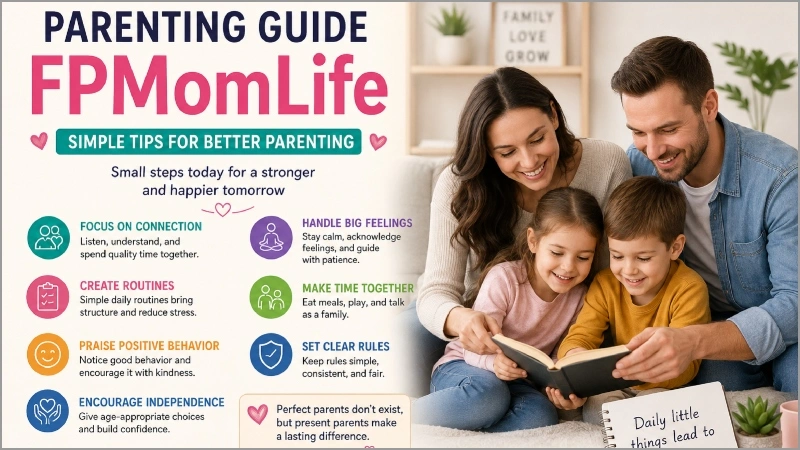
A practical parenting guide fpmomlife can help families move away from unrealistic ideas of “perfect parenting” and focus on habits that actually work in everyday life. From handling tantrums to creating routines and building stronger connections, better parenting often comes down to small, consistent choices rather than complicated methods.
Parenting looks different in every household. A strategy that works beautifully for one child may not work for another. The goal is to understand your child, stay consistent, and create a home where children feel safe, supported, and encouraged to grow.
Focus on Connection Before Correction
Children often respond better to guidance when they feel connected to the adult helping them.
Instead of immediately saying, “Stop crying,” try acknowledging what happened:
“You’re upset because playtime is over. I know it’s hard to stop when you’re having fun.”
This does not mean giving in to every demand. It means showing your child that their feelings are understood while still maintaining the boundary.
The CDC recommends active listening, empathy, and positive communication as ways to strengthen parent-child relationships.
Create Simple Family Routines
Predictable routines can make busy family life easier. Children know what comes next, while parents have fewer decisions to make throughout the day.
A basic routine might include:
- Getting dressed after breakfast
- A regular homework period
- Outdoor or active play
- Family dinner
- Reading before bedtime
- A consistent bedtime
- You don’t have to plan out every part of the day.
A few dependable anchors can provide enough structure. The CDC notes that consistency, predictability, and follow-through help children understand expectations and feel secure.
Use Clear Rules Instead of Constant Warnings
Long explanations rarely work during a stressful moment. Keep instructions short and tell children what you want them to do.
Instead of:
“Stop making such a mess and put everything away right now!”
Try:
“Please put the blocks in the box before we start dinner.”
Then follow through calmly.
A useful parenting guide fpmomlife approach is to choose a small number of important family rules and apply them consistently. Children learn more from repeated patterns than from occasional lectures. For more helpful parenting advice, explore our website.
Praise Specific Positive Behavior
Children need to know when they are doing something well. However, specific praise usually provides more useful feedback than a general “Good job.”
For example:
- “You waited for your sister to finish.”
- “You put your shoes away without being asked.”
- “I noticed you kept trying when that puzzle was difficult.”
Specific praise tells children exactly which behavior you want to encourage. The CDC recommends labeled praise because it helps children understand what they did right.
Make Time for Child-Led Play
You do not need expensive toys or elaborate activities to connect with your child.
Set aside 10–15 minutes and let your child choose the activity. Build with blocks, draw pictures, play pretend, or simply talk.
During this time, put your phone away if possible and follow their lead. You can describe what they are doing rather than turning the activity into a lesson.
For example:
“You built a really tall tower. Now you’re adding another block.”
Child-led play can support independence, confidence, communication, and connection.
Handle Tantrums Without Losing Control
Tantrums can test even the calmest parent. When emotions are high, trying to reason through every detail often makes the situation worse.
A better approach is to:
- Stay nearby and keep your voice calm.
- Make sure everyone remains safe.
- Acknowledge the feeling.
- Keep the boundary simple.
- Talk about the lesson after your child settles down.
For example, if your child wants another snack before dinner, you might say, “I know you’re hungry. Dinner is coming soon. You can have water while we wait.”
The response may not stop the tantrum immediately. The goal is to model calm behavior while maintaining a reasonable limit.
Encourage Independence
Good parenting is not about doing everything for your child. Give children age-appropriate opportunities to participate.
A young child might:
- Choose between two outfits
- Put toys away
- Help set the table
- Carry their own backpack
- Choose a book for bedtime
The CDC recommends supporting children’s growing independence through age-appropriate activities and choices.
Protect Your Own Energy
Parents sometimes focus so heavily on their children that they ignore their own basic needs. Exhaustion can make patience much harder.
When possible, create small opportunities to recharge. Take a short walk, share responsibilities with another adult, enjoy a quiet cup of coffee, or simply take a few minutes without household demands.
Taking care of yourself does not mean neglecting your family. It can help you respond instead of reacting when the day becomes difficult.
Don’t Compare Your Family to Others
Social media can make other families appear perfectly organized, constantly happy, and always successful. Family life is often full of imperfect, everyday moments.
Children develop at different rates, and families have different schedules, personalities, resources, and challenges. Focus on your child’s progress rather than comparing your household with someone else’s highlight reel.
A strong parenting guide fpmomlife should offer ideas that families can adapt rather than present one rigid formula for raising children.
Choose Progress Over Perfection
There will be mornings when everyone is late, evenings when patience disappears, and days when your carefully planned routine falls apart. That does not make you a bad parent.
What matters is what you do next.
If you lose your temper, apologize. If a routine stops working, adjust it. If your child struggles with a behavior, look for the reason behind it and teach a better response.
The best parenting guide fpmomlife is not about creating perfect parents. It is about helping families build practical habits that support connection, consistency, confidence, and healthy development.
Parenting is a long process, and small improvements repeated over time can make a meaningful difference. For age-specific developmental and positive-parenting guidance, the CDC provides resources covering infancy through preschool years. Find helpful parenting insights and practical tips on our website.